The carbon tax now adds significantly to our driving and heating costs. So what exactly is it and how much does it impact on your pocket?
The carbon tax is a charge applied to carbon-emitting fuels such as natural gas, home heating oil, and petrol and diesel. Introduced in 2010, the tax is intended to reduce carbon dioxide emissions in Ireland with the money raised also used to finance grants for home retrofits.
The charge is currently €71 per tonne of CO₂ emitted by the fuel, meaning more polluting fuels are taxed more. The rate was increased from €63.50 per tonne of CO₂ in the 2026 Budget. However many environmental campaigners have called for the tax to be increased significantly and the Government has set a target of €100 per tonne by 2030.
However, according to the ESRI, the real cost of carbon, if accounting for its warming impact, is likely somewhere in the range of €150-€200 per tonne, which, if implemented, would drastically increase our gas, driving and heating costs.
What does the carbon tax cost me on my gas bill?
All natural gas suppliers in Ireland are obliged to add a carbon tax charge to their customers' bills, which works out at just under 1.4 cent (including VAT) for every kWh of gas used.
You should see the exact charge listed as a line item (excluding VAT) in the "bill breakdown" section of your gas bill.
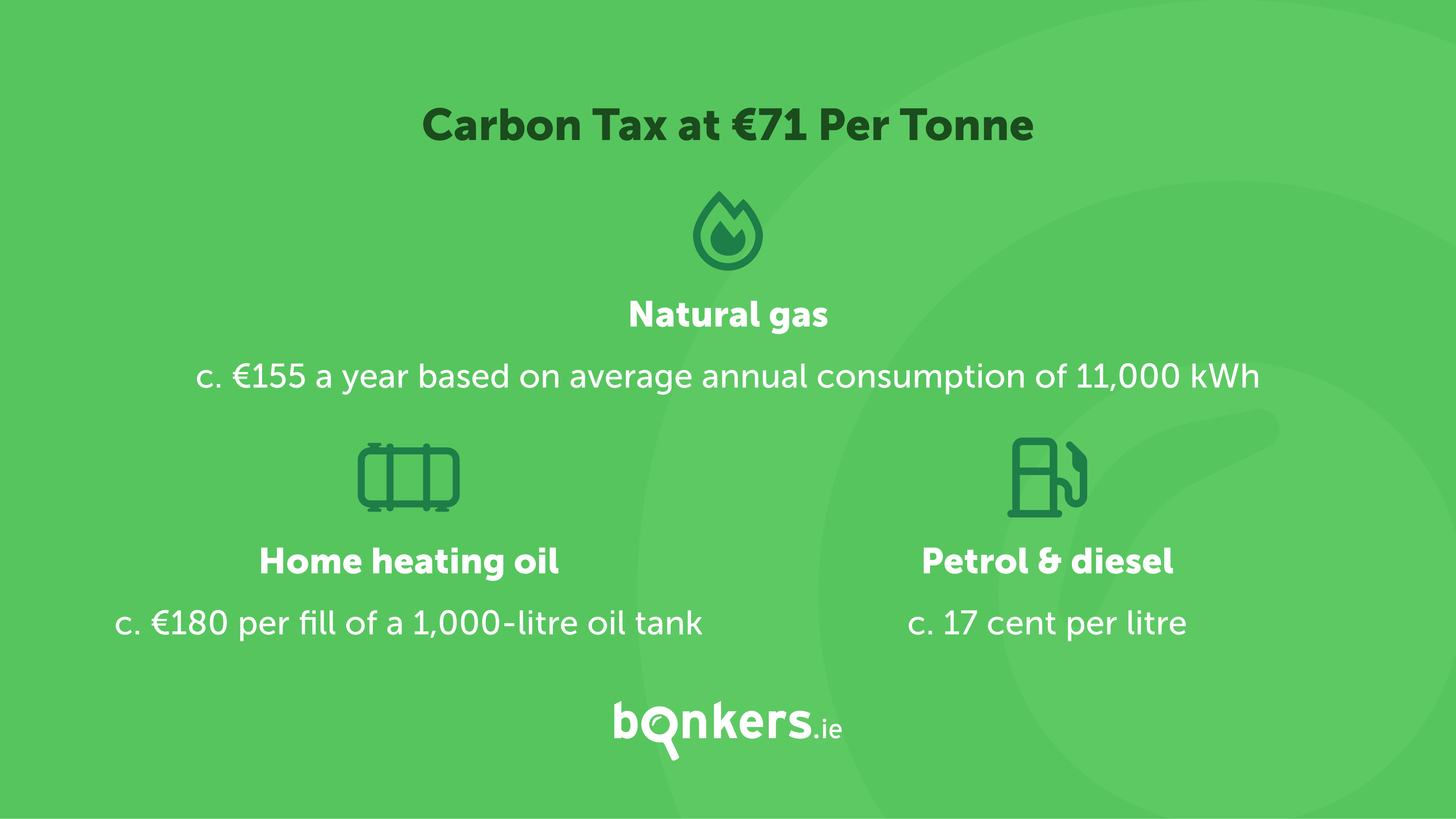
The average Irish household uses around 11,000 kWh of gas every year, meaning the carbon tax adds roughly €155 annually to your heating costs — or just under €26 on a typical bi-monthly bill.
Carbon tax is not applied to electricity bills (although here there is the PSO levy).
Everyone pays the exact same charge. Though as it's applied per kWh, the more gas you use, the higher your carbon tax bill will be.
Petrol and diesel
At the moment the carbon tax adds around 16 cent to every litre of petrol and just over 18 cent to a litre of diesel. Of course this is on top of VAT, excise duty and the NORA levy which add another 90 cent or so to a litre of petrol and around 80 cent to a litre of diesel.
Based on the fact that the average Irish motorist drives around 17,000km a year in a petrol vehicle and 24,000km in a diesel vehicle, the tax is adding around €150 a year to your driving costs if you have a petrol car and €199 a year if you're driving a diesel car (based on 5.5 litres per 100km for petrol vehicles and 4.6 litres per 100km for diesel).
Home heating oil
Carbon tax on home heating oil is based on how much CO₂ the fuel produces, but in practice it’s charged as a fixed cost per litre, which is currently around 18 cent per litre at today’s rate.
This means if you're filling up a 1,000-litre tank you'll pay around €180 in carbon tax.
However the charge is not usually broken out separately on your bill. It’s usually just baked into the price you're quoted from suppliers.
What about the business sector?
The farming sector is one of the biggest emitters of CO₂ in Ireland. However the agricultural sector, as well as the aviation sector which is another large contributor, are largely exempt from the tax for now.
How much does the carbon tax raise and where does the money go?
The carbon tax now raises close to a billion euro a year for the Government.
Most of the money is ringfenced to help finance green initiatives and other climate-related policies such as home retrofits as well as being used to tackle energy poverty.
Some of the tax is also used to help farmers address the climate and environmental challenges they face in the agricultural sector.
However some of the money simply gets used for general day-to-day Government spending.
Will a carbon tax solve our climate change problems?
It depends.
Critics will argue that the tax hasn't radically changed people's behaviour and that it's merely yet another tax on hard-pressed consumers.
Supporters will argue that it's the only way to encourage both businesses and consumers to move away from carbon-intensive fuels and to place the planet on a more environmentally sustainable path going forward.
The truth probably lies somewhere between the two.
Whether we like it or not, the polluter pays principle means a carbon tax is going to remain a core part of Ireland's climate change strategy over the coming years. However the Government will have to reward those who make more environmentally conscious choices and invest in things like proper public transport too.
How can I save?
Using wood to fuel your fire and maybe investing in some woolly jumpers to keep you warm on chilly evenings will help reduce your heating costs. Changing to an electric or hybrid car will also reduce your driving fuel costs.
And of course, investing in a deep retrofit to improve your home's energy efficiency and replacing your gas boiler with a heat pump is another option and is ultimately one of the key aims of the carbon tax in the first place. Take a look at this article to review your finance options for retrofitting and learn all about retrofitting in this episode of our bonkers.ie podcast.
However, the best and easiest way to save is by reducing your gas consumption and checking to see if you’re on the best rate out there.
You can compare natural gas prices on bonkers.ie right now and switch to a cheaper supplier in just minutes. Alternatively, you can check out dual fuel deals if you’re looking to save on electricity too.