Learn how to claim the Mortgage Interest Tax Credit (MITC) in Ireland
Overview
The Mortgage Interest Tax Credit (MITC) is a government initiative introduced to assist homeowners burdened by rising interest rates. Following Budget 2026, the scheme has been extended to include the 2025 and 2026 tax years. Qualifying homeowners can claim relief based on the increase in their mortgage interest payments compared to the benchmark year of 2022.
Key Relief Parameters (2025–2026):
- Relief Value: For 2025, the credit is worth 20% of the interest increase, capped at €1,250. For 2026, a reduced rate applies: you can claim 20% of 50% of the interest increase, with the cap lowered to €625.
- The 2022 Benchmark: All claims are calculated by comparing the interest paid in the claim year (2023, 2024, 2025, or 2026) against the total interest paid in 2022.
- Mortgage Balance Requirement: To qualify, your outstanding mortgage balance must have been between €80,000 and €500,000 on 31 December 2022.
Eligibility & Compliance:
- Property Type: The relief applies only to your Principal Private Residence (main home). Investment properties and buy-to-lets are strictly excluded.
- Tax Compliance: You must be up to date with your Local Property Tax (LPT) obligations and have paid sufficient Income Tax to utilize the credit.
- Qualified Lenders: Your loan must be held with a qualifying lender listed as a credit information provider by the Central Bank of Ireland.
Claiming Process:
- Documentation: You must obtain a Certificate of Mortgage Interest for both 2022 and your specific claim year from your lender.
- Submission: Claims are processed via Revenue’s myAccount (for PAYE taxpayers) or ROS (for self-assessed taxpayers) by filing an Income Tax Return for the relevant year.
Understanding the Mortgage Interest Tax Credit
Rising interest rates have placed a significant financial burden on households across Ireland. Whether you are on a tracker mortgage, a variable rate, or have recently rolled off a fixed-rate period, you have likely noticed a jump in your monthly repayments. To help alleviate this pressure, the government introduced the Mortgage Interest Tax Credit.
This relief is not an automatic payment; it is a tax credit that you must actively claim. It specifically targets the increase in interest you have paid between a qualifying year (such as 2023 or 2024) and the benchmark year of 2022.
The relief is calculated at 20% of the increase in interest paid. For example, if you paid €2,000 more in interest in 2023 than you did in 2022, you could claim 20% of that €2,000 difference. This would result in a €400 tax credit. However, the maximum credit you can claim per property is €1,250. This means even if your calculation results in a higher figure, the payout is capped at this amount.
Who is eligible for the relief?
Before you attempt to claim, you must ensure you meet the specific qualifying conditions set out by Revenue. This relief is targeted at homeowners with a specific mortgage balance.
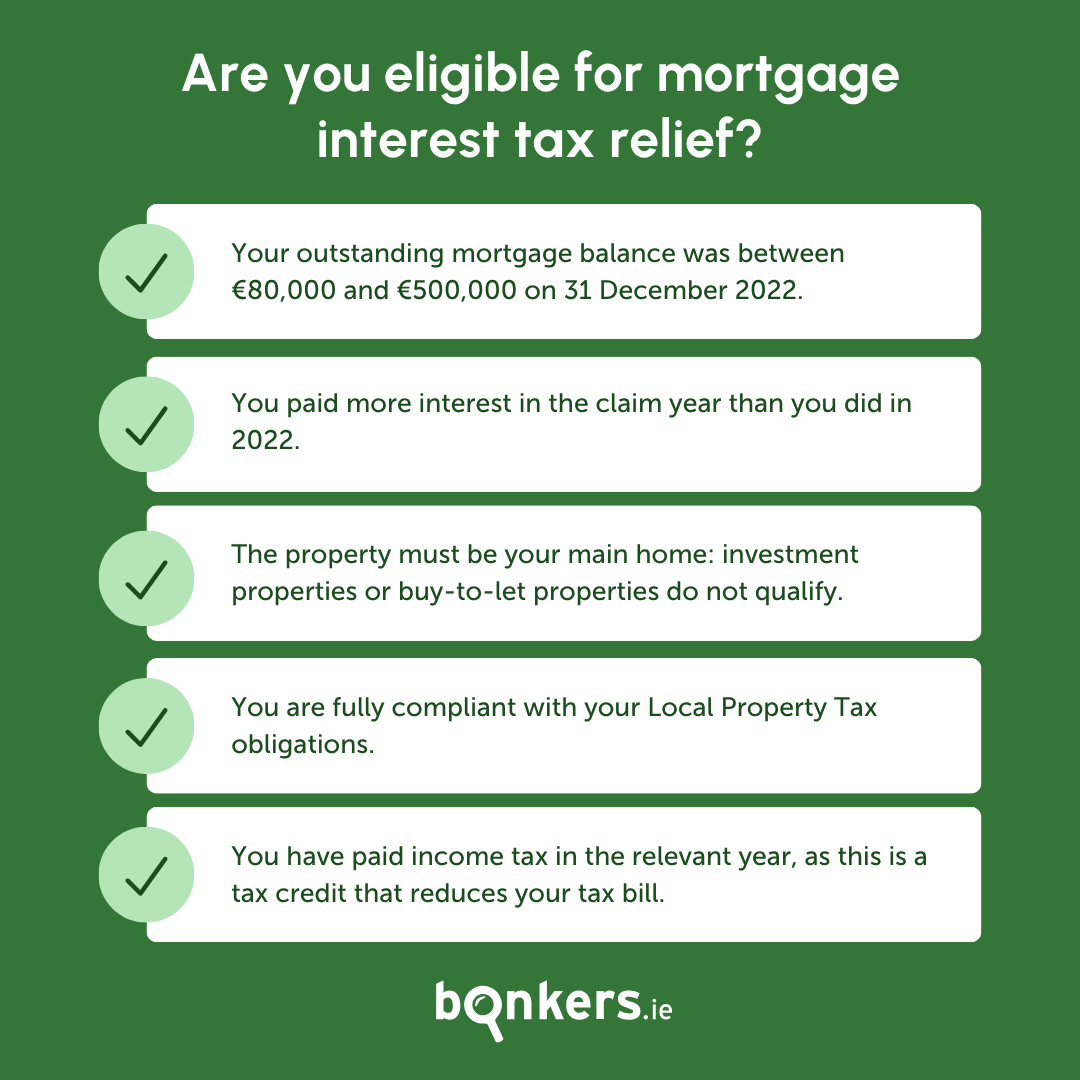
To qualify, you must meet the following criteria:
- Outstanding balance: Your outstanding mortgage balance must have been between €80,000 and €500,000 on 31 December 2022. If your balance was lower or higher than this range on that specific date, you cannot claim the credit.
- Interest increase: You must have paid more interest in the claim year (e.g. 2023 or 2024) than you did in 2022. If your interest payments remained the same or decreased, no relief is available.
- Principal Private Residence: The property must be your main home. Investment properties or buy-to-let properties do not qualify.
- LPT Compliance: You must be fully compliant with your Local Property Tax (LPT) obligations. If you have outstanding LPT payments or returns, you will not be able to claim the credit.
- Income Tax: You must have paid income tax in the relevant year, as this is a tax credit that reduces your tax bill.
Gathering the necessary documents
You cannot claim this relief without the correct paperwork. Revenue requires proof of the interest you paid. You will need to download a "Certificate of Mortgage Interest" from your lender.
Most banks have made this document available through their online banking portals or mobile apps. You need a certificate for the year you are claiming for (e.g. 2023) and for the comparison year (2022). These documents confirm the exact amount of interest charged and paid, as well as your outstanding balance on the qualifying dates.
Do not rely on your standard annual mortgage statement, as it may not display the information in the format Revenue requires. Look specifically for the Certificate of Mortgage Interest.
Step-by-step guide to claiming
Once you have your documents, the process is handled entirely online.
For PAYE taxpayers:
- Log in to myAccount on the Revenue website.
- Select "Review your tax 2020–2023" (or the relevant operational year).
- Request a "Statement of Liability".
- Select "Complete your Income Tax Return".
- Navigate to the "Tax Credits & Reliefs" page.
- Select "You and your family" and click on "Mortgage Interest Tax Credit".
- Enter the information from your Certificate of Mortgage Interest documents.
- Upload the certificates as proof.
For self-assessed taxpayers:
If you are self-employed, you will claim this credit through ROS (Revenue Online Service) when filing your annual Income Tax Return (Form 11). The section for the Mortgage Interest Tax Credit is located within the "Calculate" tab of your return. You will need to input the same figures regarding interest paid in 2022 and the claim year.
Summary Table
|
Criteria |
Requirement |
|
Mortgage Balance |
Must be between €80,000 and €500,000 on 31 December 2022. |
|
Relief Amount |
20% of the increase in interest paid compared to 2022. |
|
Maximum Credit |
Capped at €1,250 per property for 2025 tax year. Reduced to €625 for 2026 tax year. |
|
Property Status |
Must be your main home (Principal Private Residence). |
|
Compliance |
Local Property Tax (LPT) must be paid and up to date. |
Don't overpay on your bills. Switch your mortgage, energy, or insurance provider with bonkers.ie and see how much you could save.