In this guide, we provide Irish expats with advice on how to best prepare themselves for applying for a mortgage after they move back to Ireland.
Overview
This guide provides a strategic framework for Irish expats and foreign nationals seeking to secure a mortgage in Ireland. It details the logistical requirements for converting foreign financial history into a successful Irish mortgage application.
Key Residency & Financial Parameters:
- Foreign Credit History: Lenders scrutinise the last five years of your financial behaviour. You must provide a foreign credit report (e.g., Experian/Equifax) and six months of statements from all overseas accounts.
- Deposit Requirements:
- Returning Residents: Usually qualify for the standard 10% deposit (90% LTV) once residency is re-established.
- Non-Residents: Buying while still living abroad typically requires a much higher deposit of 30%–35%.
- Currency Stress Testing: For those earning in non-Euro currencies (GBP, USD, AUD), lenders often "discount" the income by 20% to buffer against exchange rate fluctuations during affordability checks.
Employment & Eligibility:
- Probationary Periods: You generally cannot draw down a mortgage while on probation. Most lenders require you to have completed your initial six-month probationary period in an Irish role before finalising the loan.
- Remote Work: Working in Ireland for a foreign employer is acceptable, provided you have a contract confirming your permanent Irish residency and salary security.
- First-Time Buyer Status: If you owned property abroad, you are classified as a Second-Time Buyer in Ireland. However, under current rules, both categories now require only a 10% deposit.
Government Support for Expats:
- Help-to-Buy (HTB): Most returning expats are ineligible initially, as the scheme requires a record of Irish income tax paid over the previous four years.
- First Home Scheme (FHS): Returning residents are eligible for this shared equity scheme, which can bridge the gap (up to 30%) between your mortgage and the property price.
Introduction
There are few things as exciting, or as stressful, as moving countries. Whether you are an Irish citizen returning to the Emerald Isle after years in Australia, Canada, or the UK, or you are an immigrant looking to make Ireland your new permanent home, the admin can feel like a lot. Amidst the packing boxes, visa applications, and flight bookings, the prospect of securing a home is often the most pressing concern.
A common misconception is that you cannot get a mortgage in Ireland until you have lived here for several years. While the process requires more documentation and preparation than a standard application, being an expat or a new arrival does not automatically disqualify you from home ownership. In fact, many Irish lenders are quite accustomed to assessing applications from returning emigrants and foreign nationals.
However, the banking history you built up in your previous country of residence matters more than you might think. Your financial behaviour in Sydney, New York, or London will be scrutinised just as closely as if you had been living in Dublin or Cork. Lenders need to build a picture of your financial health, and when you have been abroad, that picture is composed of foreign credit checks, overseas bank statements, and employment history from different jurisdictions.
If you are planning a move, or have recently landed, preparation is your greatest asset. By understanding what Irish banks look for regarding foreign income, employment probation periods, and credit history, you can ensure your application lands on the top of the pile rather than getting stuck in administrative limbo.
Preparing Your Finances Before You Return
The most critical phase of securing a mortgage as an expat happens before you even board your flight to Ireland. Many prospective buyers make the mistake of closing all their foreign accounts and cutting ties with their overseas financial history the moment they leave. This can be a significant error. To an Irish underwriter, your financial history for the past few years is the only evidence they have of your repayment capacity.
The Importance of a Healthy Credit History
When you apply for a mortgage in Ireland, lenders will look at the last five years of your credit history. This scrutiny applies to both any dormant Irish history you may have and your active foreign history. It is vital to understand that your financial slate is not wiped clean simply by changing borders.
Lenders will assess your spending habits and financial discipline. If your foreign bank statements reveal regular online gambling, missed direct debit payments, or unarranged overdraft usage, this will severely impact your mortgage journey in Ireland. Before you plan your return, you should spend at least six to twelve months polishing your credit history. Ensure all bills are paid on time and try to clear small debts.
Furthermore, you must be prepared to undergo a foreign credit check. Irish lenders will request a credit report from the country you are leaving (such as a generic credit report from Experian or Equifax in the UK or US). A crucial logistical detail to remember is that these checks are often only valid for one month. Consequently, you may need to time the request carefully or be prepared to request a refreshed document during the mortgage application process if delays occur.
Organising Bank Statements and Paperwork
Documentation is the backbone of any mortgage application, but it is doubly important for expats. You must declare all open bank accounts you hold abroad to your mortgage lender. Selective disclosure is not an option; transparency is key to building trust with the lender.
You will generally need to provide statements for the past six months from all your bank accounts. It is far easier to download, print, or certify these documents while you still have easy access to your foreign address and digital banking profile. Once you close an account or move address, accessing historical statements can become a bit more challenging.
Lenders will examine these statements to determine your eligibility. A specific "top tip" for renters abroad is to ensure your rent is paid via a standing order or direct debit that is clearly labelled. If you have been paying your landlord in cash for the past two years, there is no paper trail to prove you can sustain regular housing payments. Without this evidence, lenders may view you as a higher risk, as you cannot demonstrate a history of meeting significant monthly financial commitments.
Savings and Debt Management
Demonstrating repayment capacity is the golden rule of Irish mortgage lending. You need to show that you can save a consistent amount of money or pay rent that is equivalent to (or higher than) your proposed mortgage repayments.
While you are still abroad, try to make regular, consistent transfers into a savings account. Lump sums are great for a deposit, but they don't prove repayment capacity in the same way that a monthly savings habit does. This shows lenders that you are financially responsible and capable of budgeting for a mortgage.
Simultaneously, you should aim to clear any foreign loans before you apply in Ireland. Outstanding debt in a foreign currency or jurisdiction complicates the affordability checks. If these loans are not cleared, the amount of money you can borrow in Ireland will be reduced significantly. Lenders may factor these debts into your affordability calculations, potentially subjecting you to a higher stress test or simply declining the application if the debt-to-income ratio is too high.
Employment Criteria for Returning Expats
One of the most common hurdles for returning expats is the employment requirement. In Ireland, the Central Bank lending rules generally limit borrowing to four times your gross annual income. However, having a high income is not enough; the income must be secure.
Probationary Periods
To be considered for a mortgage, you generally need to be in permanent employment. If you have just started a new job upon returning to Ireland, you will likely be on a probationary period, which typically lasts six months.
Strictly speaking, you will not be approved for a mortgage draw down during your probationary period. Lenders view this as a period of instability where your contract could be terminated on short notice. While you can begin the conversation with a broker or bank, you usually need to wait until you have passed probation and have a letter from your employer confirming your permanent status before you can proceed to the final stages.
Most lenders prefer to lend to applicants who have been working in Ireland for at least 12 months. However, if you have a continuous employment history in the same industry abroad and have moved to a similar role in Ireland, lenders can be more flexible, provided the probationary period is complete. You will need to provide your last three payslips to prove your employment status.
Remote Working for Foreign Employers
The rise of remote work has created a new category of borrower: the expat living in Ireland but working for a foreign company. If your job is based in another country (e.g. a tech company in London or New York) but you are permanently resident in Ireland, this is acceptable to many lenders, provided you have the correct paper trail.
You will need a letter from your foreign employer explicitly stating that you are permanently based in Ireland and that your role is secure. This letter helps lenders distinguish you from a temporary visitor. It is also worth noting that you should be paid into an Irish bank account or have a clear audit trail of your salary entering the country to satisfy anti-money laundering and affordability checks.
Self-Employed Applicants
If you are a self-employed expat, the bar is set slightly higher. Lenders accept these applications on a case-by-case basis, and the documentation requirements are rigorous. Generally, you must ensure that you have been trading for at least three years.
You will need to provide an up-to-date tax confirmation and six months of bank statements from both your company and your personal accounts abroad. If you decide to move your business to Ireland, lenders will assess the likelihood of your business achieving the same level of turnover in the Irish market as it did abroad. In many cases, you will need to trade in Ireland for around a year to prove this revenue stability before a lender will entertain a mortgage application.
Buying from Abroad vs. Buying After Return
It is important to distinguish between applying for a mortgage when you have physically returned to Ireland versus applying while you are still resident overseas. The rules, deposits, and interest rates differ significantly between these two scenarios.
Returned Expats (Residential Mortgages)
If you have moved back to Ireland and are tax resident here, you are treated similarly to any other Irish applicant, provided you satisfy the credit and employment checks mentioned above.
First-Time Buyer Status: If you have never owned a property in Ireland or abroad, you are classified as a first-time buyer. This allows you to borrow up to 90% of the property value, meaning you need a 10% deposit. However, if you bought a home in your previous country of residence, even if you have since sold it, you are not a first-time buyer. You will be considered a second-time buyer. Fortunately, following recent rule changes, second-time buyers also only require a 10% deposit (previously 20%).
Government Schemes:
- Help-to-Buy Scheme: As a returning expat, you will unfortunately likely not qualify for this scheme immediately. The Help-to-Buy scheme relies on income tax (DIRT or income tax) paid in Ireland over the previous four years. If you have been living and paying tax in Australia or Canada, you won't have the Irish tax record required to claim this rebate.
- First Home Scheme: You are, however, eligible for the First Home Scheme. This shared equity scheme allows the Government to take a share in your home (up to 30%) in return for bridging the gap between your deposit/mortgage and the property price. This can be a lifeline for returning emigrants facing high property prices.
Non-Resident Mortgages (Buying from Abroad)
If you plan to buy a property before you move home, or if you are purchasing a holiday home/investment property while remaining abroad, you fall into the "Non-Resident" category. This is a riskier proposition for banks, and the terms reflect that.
Mortgages for non-residents are available from lenders like AIB, Haven, and Permanent TSB, but criteria are strict. You will typically be subject to higher interest rates and require a much larger deposit.
Specific Lender Examples:
- AIB: AIB offers foreign currency (FX) loans, which are vital if you earn in Sterling or US Dollars. However, they typically require a downpayment of 35%, offering a loan-to-value (LTV) of just 65%. Crucially, AIB applies a "stress test" to your foreign salary. They may discount your foreign earnings by 20% to account for potential currency fluctuations, ensuring you can still afford the mortgage if the exchange rate turns against you.
- Permanent TSB: This lender generally offers mortgages in euro only. This means your salary must be paid in euro, and you must live in the Eurozone. If you are living in the UK or US, this option may not be available to you. They generally require a 30% deposit and have a minimum income threshold, often around €75,000.
Banking and Currency Considerations
One logistical step that often catches expats out is the requirement for an Irish bank account. This is a mandatory requirement for almost all lenders because your salary, mortgage repayments, and the deposit must be mandated from an Irish current account.
Before your mortgage can be drawn down, you must have this account active. More importantly, your deposit funds must be in the account in euro. This brings us to the risk of currency exchange.
If you are holding your savings in a foreign currency (like AUD or USD), you are at the mercy of the exchange rate until the moment you convert your funds. A fluctuation in rates could suddenly reduce the value of your deposit in euro terms, leaving you short of the 10% or 30% requirement. It is wise to keep a close eye on exchange rates and transfer your deposit sooner rather than later to lock in your buying power.
Furthermore, under the EU Mortgage Credit Directive, lenders are very cautious about "foreign currency loans." If you live in a non-Eurozone country, the bank must monitor exchange rate fluctuations. If the exchange rate varies by more than 20%, they are obliged to inform you. Because of the administrative burden and risk associated with this, some lenders simply refuse to lend to applicants earning non-euro incomes, limiting your pool of available banks.
The Application Process: A Summary of Documents
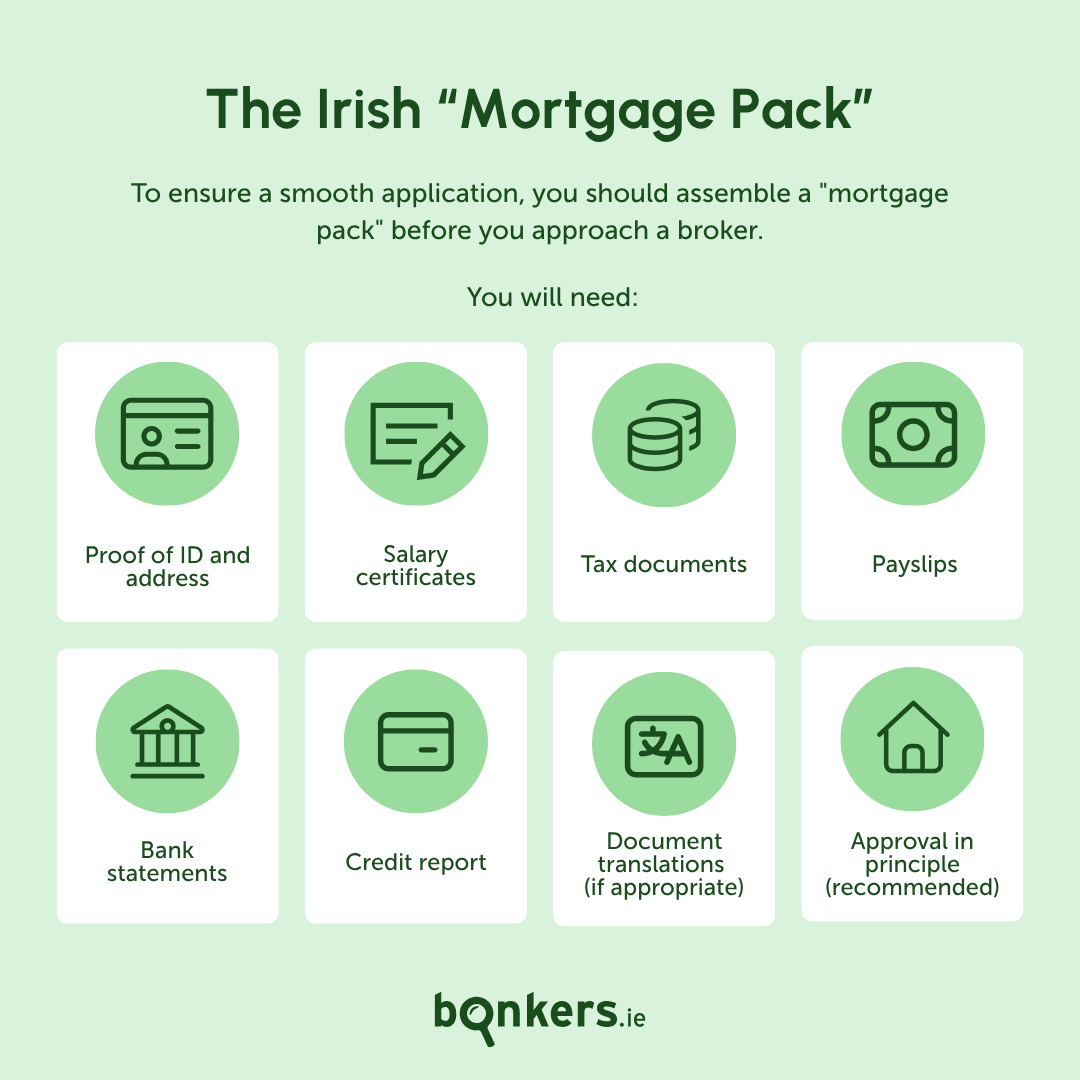
To ensure a smooth application, you should assemble a "mortgage pack" before you even approach a broker. This proactive approach demonstrates organisational skills and financial responsibility.
You will need:
- Proof of ID and Address: Passport and recent utility bills (from your current foreign address if applicable).
- Salary Certificates: A standard form signed by your employer confirming your permanency and salary.
- Payslips: Usually the last three months.
- Bank Statements: Six months of statements from all accounts (Irish and foreign).
- Credit Report: An up-to-date credit check from the country you are leaving.
- Tax Documents: If self-employed, tax clearance certs and three years of accounts.
If any of your documents are in a foreign language, they must be translated by a certified translator. This is a common requirement for those returning from non-English speaking countries in Europe or Asia.
Finally, getting "Approval in Principle" (AIP) is highly recommended. This certificate indicates that a lender is willing to lend you a certain amount in principle. In the competitive Irish property market, estate agents (auctioneers) may not even let you view a property, let alone bid on it, unless you have this approval in hand.
Conclusion
Securing a mortgage as an expat or returning emigrant is certainly more document-heavy than a standard application, but it is entirely achievable. The key takeaways are to prepare early, protect your credit rating in your current country of residence, and understand the specific requirements regarding deposits and employment.
Whether you are saving for a 35% deposit to buy from abroad or waiting to pass your probation period after returning home, knowing the rules of the game allows you to plan your strategy effectively. By gathering your foreign banking history and understanding the nuances of the "non-resident" versus "resident" mortgage products, you can navigate the market with confidence and secure your own corner of Ireland.
Summary Table
|
Requirement |
Returning Resident (Home) |
Non-Resident (Buying from Abroad) |
|
Deposit Required |
10% (First and Second-Time Buyers) |
Typically 30% - 35% |
|
Employment Status |
Permanent (probation usually passed) |
Permanent / Self-employed |
|
Income Assessment |
Standard (4x Salary) |
Often stress-tested (e.g. currency discounted by 20%) |
|
Currency |
Euro income preferred |
Euro or major currencies (GBP/USD) depending on lender |
|
Key Schemes |
First Home Scheme (Eligible) / Help-to-Buy (Likely Ineligible due to tax history) |
Generally Ineligible |
|
Documentation |
6 months foreign + Irish bank statements |
6 months foreign statements + foreign credit check |
Get the best mortgage rate today. Don't navigate the complex world of expat mortgages alone. Compare rates and get expert advice tailored to your international situation.