Whether you're a first-time buyer or moving home, understanding the Central Bank's mortgage lending rules is an essential first step.
Overview
This guide summarizes the Central Bank of Ireland’s mortgage lending regulations, which cap borrowing based on income and property value to ensure financial stability.
Core Lending Limits
Borrowers must meet two primary criteria for a principal home:
- Loan-to-Income (LTI): * First-Time Buyers (FTBs): Maximum 4x gross annual income.
- Second/Subsequent Buyers: Maximum 3.5x gross annual income.
- Loan-to-Value (LTV): A minimum 10% deposit is required for all buyers (max 90% LTV).
Exemptions & Flexibility
Lenders can grant "exemptions" to exceed these limits for approximately 15% of their lending quota:
- Capacity: Borrowing can increase up to ~4.75x income.
- Eligibility: Generally reserved for high-earners (approx. €60k+ single/€80k+ joint) with strong credit profiles.
- Bridging Loans: As of April 2026, certain short-term bridging finance is exempt from LTI limits to facilitate homeowners "rightsizing" or moving before their original home sells.
Switchers & Affordability
- Switching: Core LTI rules do not apply to those switching an existing mortgage balance, though a 10% equitybuffer is usually required.
- Affordability: Banks perform independent stress tests on net income, existing debt, and lifestyle costs; meeting the Central Bank limits does not guarantee loan approval.
Introduction
Whether you are a first-time buyer taking your initial steps onto the property ladder or an existing homeowner looking to move to a new house, getting a mortgage requires careful planning. If you are looking to get a mortgage in Ireland, it is incredibly important that you get up to speed with the Central Bank’s mortgage lending rules.
These Central Bank mortgage lending rules were initially introduced back in 2015 and have fundamentally changed the property landscape in Ireland. Essentially, the rules dictate exactly how much you are allowed to borrow for a mortgage in relation to your income, as well as how much money you must have saved up for a deposit.
The core purpose of these restrictions is to ensure that financial institutions lend money sensibly and to prevent borrowers from taking on unsustainable levels of debt. Following an in-depth review of the framework, the Central Bank of Ireland amended the rules in 2022 to reflect the modern economic environment.
If you are currently asking yourself "how much mortgage can I get?", understanding these regulations is your essential first step. In this guide, we will break down the loan-to-income limits, the loan-to-value requirements, and how you can practically estimate your borrowing capacity before you begin your mortgage application.
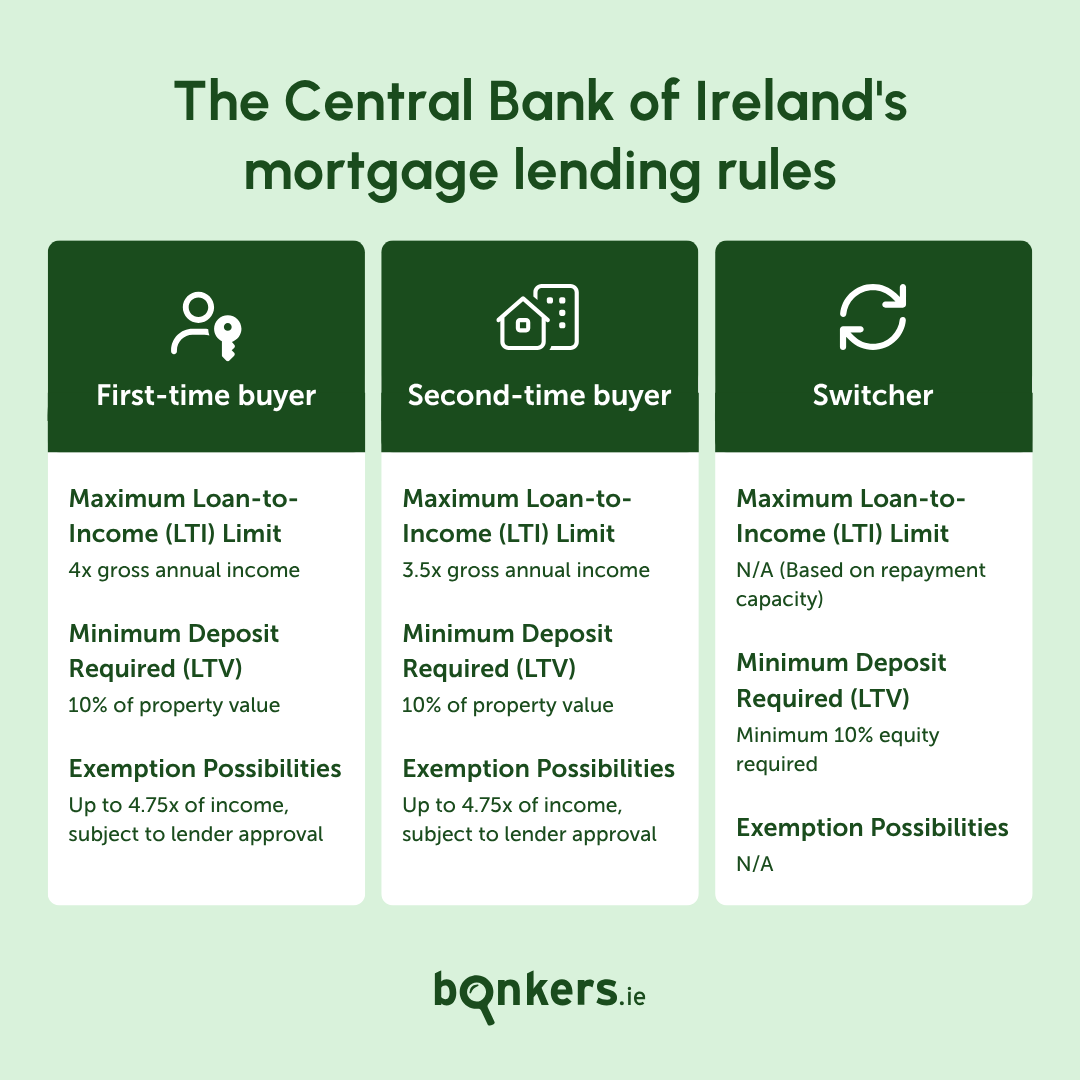
Understanding the two main mortgage lending rules
When applying for a mortgage loan, lenders will assess your application against two primary Central Bank limits. You must satisfy both of these criteria to achieve a mortgage approval for your principal home.
1. The loan-to-income (LTI) limit
The Central Bank's loan-to-income limit restricts the maximum amount of money someone can borrow based on their gross annual income.
The rules state that:
- If you are a first-time buyer, you can borrow a maximum of four times your gross annual income.
- If you are a second-time or subsequent buyer, you can borrow a maximum of 3.5 times your gross annual income.
These strict multiples apply regardless of how much you earn overall.
To put this into context, let us say that you are on a salary of €50,000 a year. This means you are allowed to borrow a maximum of €200,000 under the Central Bank's lending rules if you are a first-time buyer. If you are buying with a partner who also earns a salary of €50,000, your combined household income becomes €100,000, and that maximum borrowing amount doubles to €400,000.
However, if you are a second-time buyer and you earn €50,000 a year, the lower multiple applies. Therefore, you can only borrow a maximum of €175,000. For a joint application between second-time buyers earning €100,000 combined, the maximum limit would be capped at €350,000.
2. The loan-to-value (LTV) ratio and deposit rules
The second major mortgage lending rule relates to the loan-to-value ratio that lenders are required to observe. This refers to the percentage of the residential property’s total value that you are allowed to borrow, which subsequently dictates how much money you must pay upfront in the form of a deposit.
Because of this, it is often simply called the "deposit rule".
Following the recent updates by the Central Bank, both first-time buyers and second-time or subsequent buyers are allowed a maximum loan-to-value limit of 90%. This means you are legally required to have a minimum deposit of at least 10% for any property you wish to purchase.
Let us look at a practical example. Say that you are a first-time buyer and you want to buy a house for €300,000. The 90% LTV limit means you will need a minimum deposit of €30,000 saved up before any bank can lend you the remaining €270,000.
If you are targeting a more expensive property, such as a family home worth €450,000, you will need to provide a 10% deposit of €45,000, leaving a mortgage balance of €405,000. Remember that your deposit must generally come from your own savings or a non-repayable cash gift from an immediate family member.
What counts as income for your mortgage application?
When asking "how big of a mortgage can I get with my income?", it is vital to know exactly what the banks count as valid earnings.
Your basic gross annual salary is the primary figure used. However, many people also receive social welfare payments, commission, regular bonuses, shift allowances, and other sources of income in addition to their standard monthly or weekly wage.
Lenders will often take this additional income into account when deciding how much they can lend you under the Central Bank's loan-to-income rule. But it is important to note that all the lenders view these variable sources of income slightly differently. Some banks might take 100% of your guaranteed bonus into account, while others might only accept 50% of your overtime or commission earnings.
This differing criteria means you may be able to secure a slightly bigger mortgage with one lender over another, simply based on how they assess your payslips. If you apply for a mortgage with a mortgage broker like bonkers.ie, we will be able to tell you exactly which lender will offer you the biggest mortgage for your particular financial circumstances.
Practical examples: How much mortgage can I get?
To help you understand affordability and what your monthly repayments might look like, let us work through some practical scenarios combining both the LTI and LTV limits.
It is crucial to remember that your borrowing power is restricted by whichever limit is lower. Even if your income allows you to borrow €400,000, you cannot actually draw down that amount unless you have the required 10% deposit for the property's purchase price.
Scenario A: The single first-time buyer
- Applicant: Single first-time buyer
- Gross annual income: €60,000
- LTI maximum borrowing capacity (4 times income): €240,000
- Savings available for deposit: €30,000
- Maximum property purchase price: €270,000 (Because €240,000 is exactly 90% of €270,000, and the €30,000 covers the 10% deposit).
Scenario B: The joint second-time buyers
- Applicants: Joint second-time buyers
- Combined gross annual income: €120,000
- LTI maximum borrowing capacity (3.5 times income): €420,000
- Target property price: €500,000
- Required 10% deposit (LTV rule): €50,000
- Assuming they have the €50,000 deposit from the sale of their previous home, they will need a mortgage of €450,000. However, their LTI limit caps them at €420,000. They will need to bridge that €30,000 gap with additional savings or secure an exemption to proceed.
Before you progress to the pre-arrears or formal application stage, we strongly recommend using a dedicated mortgage calculator to estimate what your variable interest rate or fixed-rate monthly repayments will be based on these borrowing limits.
Mortgage exemptions: Can you borrow more than the limit?
One of the most common questions from prospective buyers is: "Can you borrow more than 3.5 or four times my salary?"
The short answer is yes. In any one calendar year, 15% of the mortgages that lenders give out to first-time buyers can legally breach the standard income limit or the minimum deposit requirement. Furthermore, 15% of mortgages given to second-time or subsequent buyers can also breach the lending rules.
These permitted breaches are officially called "exemptions".
With an income exemption, a mortgage seeker can potentially borrow up to around 4.75 times their gross annual income, rather than the standard limits.
However, you must be aware that banks do not always use up their full regulatory quota of exemptions. So just because they are theoretically available, it does not mean you will automatically get one.
How do I get a mortgage exemption?
Firstly, you need to know that you can usually only get an exemption under one of the lending rules. It is extremely rare that a financial institution will allow you to breach both the loan-to-income limit as well as the loan-to-value ratio. It is almost always either one or the other.
Whether you get an exemption will depend heavily on your credit worthiness, your proven repayment ability, the quality of your mortgage application, and whether the specific lender still has room to give out an exemption that year.
Because exemptions are highly sought after, they are often all used up by the middle of the calendar year. Therefore, if you want to apply for one, the earlier in the year that you submit your application, the better your chances will be.
Banks will usually only grant a mortgage exemption to people in stable, professional jobs who are on higher incomes. Typically, this means earning around €60,000 or above for a single applicant and €80,000 and above for a joint application.
It is also worth noting that some banks are much more likely to offer an exemption than others. And not all lenders will offer the absolute maximum of 4.75 times your salary. Some lenders will only offer a maximum limit of 4.5 times your income. Your chances of navigating this complex landscape and getting approved for an exemption are significantly higher if you go through a qualified mortgage broker.
The rules are a limit, not a guarantee
It is incredibly important to remember that the Central Bank's lending rules only dictate the absolute maximum amount you can theoretically be lent. It is not a guaranteed entitlement.
Lenders have a responsibility to assess true affordability. Before deciding how much they will lend you, banks will thoroughly examine your bank statements to take into account your other outstanding loans, credit cards, childcare outgoings, regular bills, and everyday lifestyle commitments.
If they determine that a maximum mortgage loan would leave you financially stretched and struggling to meet your mortgage repayments, they will offer you a smaller sum.
Do the rules apply if you are switching your mortgage?
If you are simply looking for better value and are thinking of switching your mortgage to a new provider, you will be happy to know that the Central Bank's core LTI lending rules do not apply to switchers.
When remortgaging an existing property for the outstanding balance, the stringent limits are relaxed. However, you still need to prove affordability. Furthermore, most banks will not let you switch if you are currently in negative equity, and the vast majority will require you to have built up at least 10% equity in your home before they will accept you as a switching customer.
Summary table of the central bank lending rules
To make things easy to digest, here is a quick summary table of the Central Bank of Ireland's current mortgage lending rules for residential property purchases.
|
Buyer type |
Maximum loan-to-income (LTI) limit |
Minimum deposit required (LTV) |
Exemption possibilities |
|
First-time buyer |
Four times gross annual income |
10% of property value |
Up to 4.75 times income (subject to lender approval) |
|
Second-time buyer |
3.5 times gross annual income |
10% of property value |
Up to 4.75 times income (subject to lender approval) |
|
Switcher |
N/A (Based on repayment capacity) |
Minimum 10% equity required |
N/A |
Get your mortgage with bonkers.ie
Our mortgage broker service finds you the best rate from leading Irish lenders, and guides you through securing your mortgage protection and home insurance too. Start your mortgage journey today.