This guide provides an in-depth analysis of the Irish mortgage rate landscape in 2026, explaining the economic forces that drive borrowing costs and how you can strategically navigate them.
Overview
Current Market Dynamics (2026):
- Rate Environment: Following a period of stability, Irish mortgage rates in early 2026 typically range from 3.2% to 4.5% for fixed products and 3.5% to 5.2% for variable options.
- The ECB Influence: While the European Central Bank (ECB) has moved into a "stabilization phase" with the main refinancing rate at 2.15%, Irish rates remain higher than the Eurozone average due to domestic "risk weighting" and high capital reserve requirements for banks.
- Competition: The "Big Three" pillar banks (AIB, BOI, PTSB) still dominate, but new digital-first lenders like Revolut, MoCo, and Nua Money are intensifying competition, particularly for switchers.
Key Factors Determining Your Rate:
- Loan-to-Value (LTV) Bands: Your interest rate is tied to your equity. Crossing a "band" (e.g., moving from 80% LTV down to 60% LTV) can unlock the market's lowest rates, as it reduces the risk to the lender.
- APRC vs. Nominal Rate: The Nominal Rate is the headline interest you pay, but the APRC (Annual Percentage Rate of Charge) is the true cost of credit, accounting for legal fees, valuations, and setup costs.
- Green Incentives: Homes with a BER of B3 or higher qualify for "Green Rates," which are currently among the most competitive in the market, often sitting at or near 3.0%.
Why Understanding Your Mortgage Rate Matters
If you have a mortgage or are planning to get one, you likely check the news with a sense of trepidation. The landscape of lending in Ireland has shifted dramatically over the last few years. We have seen the exit of major lenders like Ulster Bank and KBC, the rise of non-bank lenders, and a rollercoaster of interest rate hikes from the European Central Bank (ECB).
For many Irish households, the mortgage is the single largest monthly outgoing. Even a fractional percentage difference in your interest rate can equate to tens of thousands of euro over the lifetime of a mortgage. Yet, despite the high stakes, the mechanics of why rates are what they are and why they seem persistently high in Ireland often remain a mystery.
This guide aims to demystify the Irish mortgage market. We will look at the specific reasons why borrowing costs here are higher than in our neighbouring countries, explain the jargon that lenders use, and provide actionable advice on how you can secure the best value for your home. Being money conscious isn't just about cutting back on daily coffees; it is about optimising your largest financial commitments.
Mortgage Interest Rates Explained
Before we dive into the complex economic reasons behind high rates, we need to establish exactly what we are talking about when we discuss "rates."
What is an interest rate?
Put simply, the interest rate is the cost of borrowing money. It is a percentage of the loan amount that you pay the bank in exchange for them lending you the funds to buy your home. This is calculated annually but paid monthly as part of your repayment.
However, when comparing offers on bonkers.ie, you will see two different figures: the nominal rate and the APRC.
The Nominal Rate: This is the headline rate. If a bank offers you a "3.9% fixed rate," that is the nominal rate. It is used to calculate your monthly interest repayment.
The APRC (Annual Percentage Rate of Charge): This figure is crucial for true comparison. The APRC includes the interest rate plus any other costs associated with setting up the mortgage, such as valuation fees or legal fees that the bank might charge. It is designed to give you a complete picture of the cost of the loan over its entire life. If you are comparing two mortgages with the same headline rate, the one with the lower APRC is generally the better value.
The Loan-to-Value (LTV) Ratio
One of the biggest factors determining the interest rate you are offered is your Loan-to-Value ratio, or LTV. This represents the size of your mortgage relative to the value of your property.
For example, if you buy a house for €400,000 and you have a deposit of €40,000, you need a mortgage of €360,000. Your LTV is 90%.
Lenders use "LTV bands" to price their products. Generally, the lower your LTV, the lower the interest rate you will be offered. This is because a lower LTV represents less risk to the bank. If you have 40% equity in your home (a 60% LTV), the bank is almost guaranteed to get its money back even if house prices crash and they have to repossess and sell the property.
Common LTV bands where you might see rate reductions include:
- 90% (typically for first-time buyers)
- 80%
- 60% (often the lowest rates available)
This is vital information for switchers. If your house has increased in value since you bought it, your LTV might have dropped, making you eligible for a much lower rate than you are currently paying.
Why Are Mortgage Rates in Ireland So High?
This is the question on everyone's lips. When we look at data from across the Eurozone, Ireland consistently ranks toward the top for the cost of mortgage borrowing. It can feel unfair, especially when we use the same currency as countries with much cheaper borrowing costs.
There isn't one single "villain" in this story. Instead, high rates are the result of a combination of structural issues unique to the Irish market.
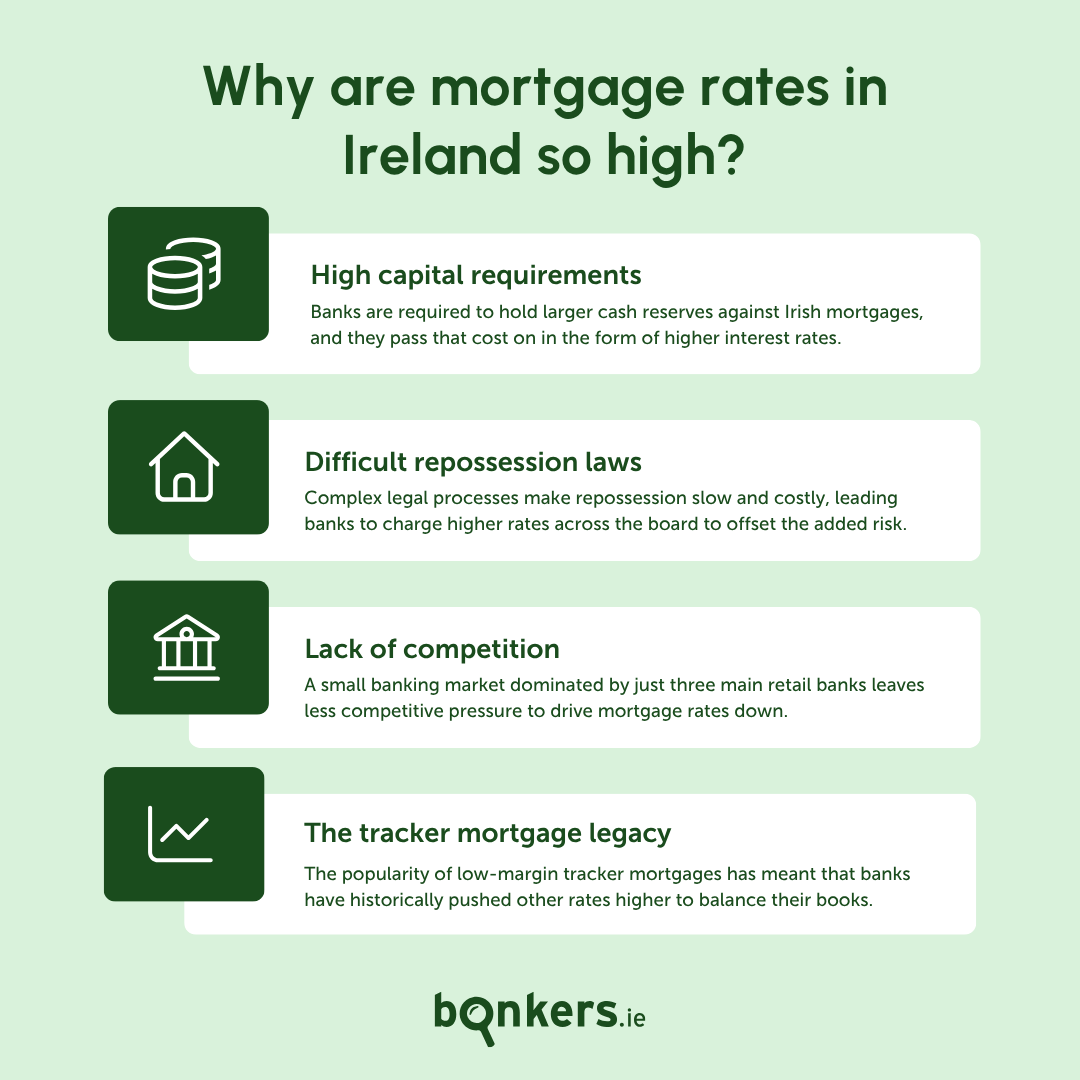
1. High Capital Requirements
Following the financial crash of 2008, Irish banks were in a precarious position. To prevent a repeat of that disaster, regulators now require Irish banks to hold significantly more capital (cash reserves) against every mortgage they issue compared to European banks.
This is known as "risk weighting." Because Irish mortgages are viewed as riskier assets by the regulators, banks must keep more money in reserve "just in case." Holding this cash is expensive for banks because that money cannot be used elsewhere to generate profit. To cover this cost, they pass it on to the consumer in the form of higher interest rates.
2. Difficult Repossession Laws
This is a sensitive but critical factor. In Ireland, the legal process for a bank to repossess a home when a borrower stops paying is incredibly long, complex, and expensive. It can take many years for a bank to recover the asset if a mortgage goes into default.
While these protections are great for keeping people in their homes during difficult times, they create a "risk premium." Lenders know that if a loan goes bad, they might not see that money again for a decade. To mitigate this risk, they charge higher interest rates to everyone. Essentially, the majority of paying customers are subsidising the cost of the small percentage of loans that go into default.
3. Lack of Competition
The Irish banking market is highly concentrated. We recently saw the departure of Ulster Bank and KBC, which reduced the number of main retail banks to just three: AIB (which also owns EBS and Haven), Bank of Ireland, and PTSB.
While we do have non-bank lenders like Avant Money, Finance Ireland, Nua Money, and ICS Mortgages adding much-needed variety, the market is still small. In a healthy market with ten or fifteen banks fighting for your business, rates would naturally be driven down. With fewer players, there is less competitive pressure to slash margins.
4. The Tracker Mortgage Legacy
Thousands of Irish homeowners are still on tracker mortgages with very low margins over the ECB rate. For a long time, these mortgages were losing money for the banks. To balance their books, banks kept standard variable rates and new fixed rates higher. While the tracker issue is slowly fading as time goes on, it has historically kept average rates in Ireland artificially high.
The Role of the ECB and Future Trends
The European Central Bank (ECB) is the central bank for the euro. Its primary job is to keep prices stable (control inflation). The main tool it has to do this is setting interest rates.
How ECB Rates Impact You
When the ECB raises its rates, it becomes more expensive for banks to borrow money on the wholesale market. Theoretically, banks pass this cost on to you. When the ECB cuts rates, borrowing should become cheaper.
However, in Ireland, the transmission is not always immediate.
- Tracker Mortgages: If you have a tracker mortgage, your rate moves automatically with the ECB. If the ECB cuts by 0.25%, your mortgage rate drops by exactly 0.25% effectively immediately.
- Variable Rates: Banks can choose whether or not to pass on cuts or hikes.
- Fixed Rates: These are influenced by what the markets think rates will be in the future (swap rates).
Will Mortgage Rates Go Down in 2026/2027?
Predicting interest rates is notoriously difficult. However, looking at the economic indicators, inflation across the Eurozone has been falling. The general consensus among economists is that the cycle of aggressive rate hikes has ended, and we are entering a period of gradual cuts.
If the ECB continues to cut rates through 2026, we should see Irish mortgage rates soften. However, due to the structural issues mentioned above (capital requirements and lack of competition), Irish rates may not fall as fast or as far as rates in Germany or France. It is unlikely we will see the return of "floor" rates (like 1% or 2%) in the immediate future, but a settling around the 3.5% to 4% mark is looking most likely, although still dependent on global economic health.
Fixed vs Variable: How to Decide
One of the most important decisions you will make is choosing between a fixed rate and a variable rate. Both have distinct advantages and disadvantages depending on your personality and financial goals.
Fixed Rate Mortgages
With a fixed rate, your interest rate and monthly repayment remain exactly the same for a set period of typically three, five, or even ten years.
Pros:
- Certainty: You know exactly how much to budget for every month.
- Protection: If ECB rates skyrocket, your rate stays the same.
- Current Value: In the current inverted market, fixed rates are often lower than variable rates.
Cons:
- Lock-in: You cannot easily switch if rates plummet elsewhere without paying a "break fee."
- Rigidity: Most banks limit how much you can overpay/pay off early on a fixed rate.
Variable Rate Mortgages
With a variable rate, the interest rate can change at any time at the discretion of the lender.
Pros:
- Flexibility: You can usually pay off lump sums or clear the mortgage entirely without penalty.
- Freedom: You can switch to another lender or rate whenever you want.
Cons:
- Uncertainty: Your repayment could go up overnight if the bank decides to raise rates.
- Cost: Currently, variable rates in Ireland tend to be higher than the best fixed rates available.
Which is better?
For the majority of people, especially those on a tight budget, a fixed rate offers peace of mind. Knowing your bill won't change for five years allows for better long-term planning. However, if you plan to sell your house in the next year or expect a large lump sum of money (like an inheritance) that you want to use to pay off your loan, a variable rate might be the smarter strategic move.
Conclusion
Navigating the Irish mortgage market requires a mix of patience and proactivity. While we cannot control the decisions made by the ECB or the capital requirements set by regulators, we can control who we borrow from and what products we choose.
The era of "set and forget" banking is over. To ensure you are getting the best value, you must treat your mortgage like your car insurance or energy provider, in that it's something that needs to be reviewed regularly. Whether it is fixing your rate to protect against uncertainty, improving your home's energy rating to access green rates, or switching lenders to escape a high variable rate, the power to save is in your hands.
Summary Table
|
Feature |
Fixed Rate |
Variable Rate |
|
Certainty |
High. Your rate never changes during the fixed term. |
Low. Your rate can rise or fall at any time. |
|
Overpayments |
Limited. Usually capped (e.g., 10% of balance). |
Flexible. Usually unlimited overpayments allowed. |
|
Switching |
Restricted. You may pay a "break fee" to leave early. |
Easy. You can switch to another lender anytime. |
|
Best For |
Budgeting and peace of mind. |
those planning to sell or pay off the loan soon. |
|
Market Trend |
Currently offers better value for most borrowers. |
Often higher rates than fixed options. |
Take control of your largest monthly expense. Whether you're buying your first home, moving home, or looking to switch to a lower fixed rate, our expert digital broker team is here to help. Compare Irish mortgage rates on bonkers.ie now.